Werx Musings

Amlak Tafari: From Handsworth to Hollywood

 The Journey of Reggae’s International Am-BASS-Ador

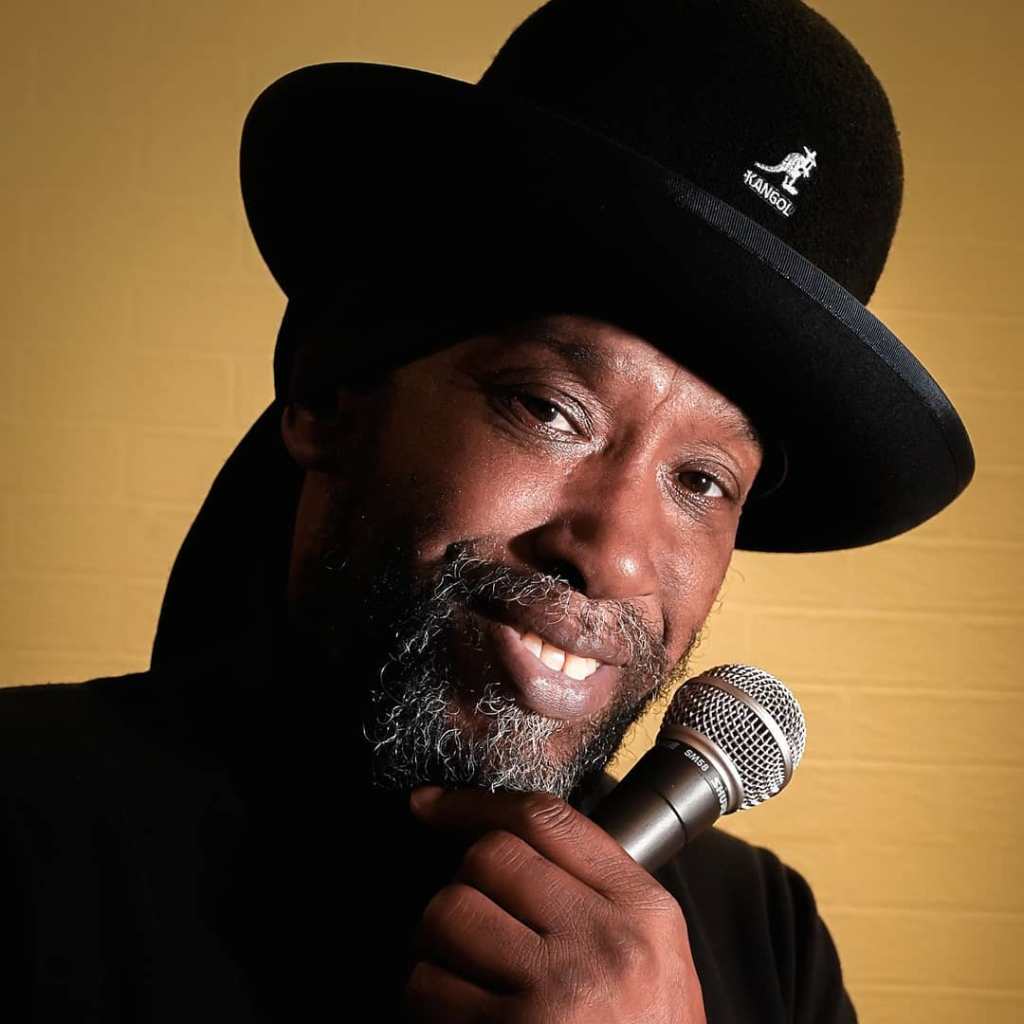
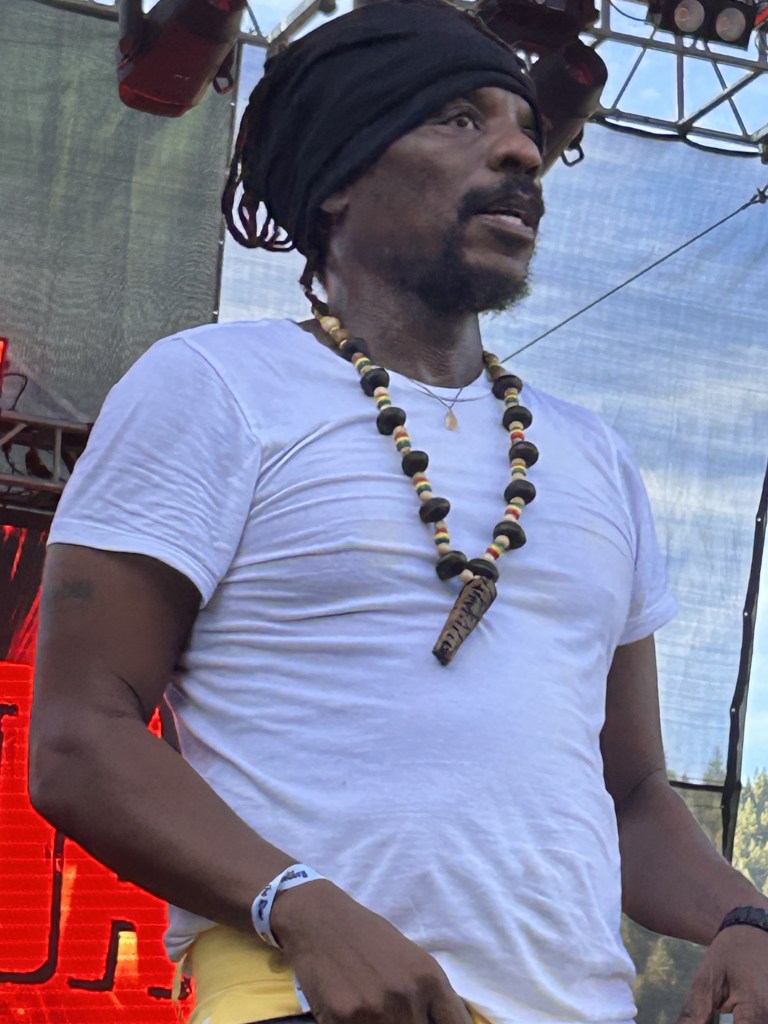
In most bands, it’s often the lead singer who garners the most attention. But for those who understand the heartbeat of a performance, it’s the musicians, the ones laying the foundation, who truly hold the groove. Such is the case with Amlak Tafari, the dynamic and high-energy bass player for the legendary British reggae band Steel Pulse. Charismatic on stage and comedic on social media, Amlak describes himself as the “International Reggae Am-BASS-Ador.” But beyond the persona lies a story of musical dedication, cultural advocacy, and global impact.

Born in Handsworth, Birmingham, UK, to Jamaican parents, Amlak’s musical journey began early. As a child, he formed a “cardboard band,” crafting instruments from Tupperware and cardboard. Like many UK schoolchildren at the time, he also learned to play the recorder and mouth organ. His first real foray into music came through the church, where he played in a steel band performing Caribbean-influenced music.

His transition to reggae began when members of a reggae band visited his church. He soon joined them, playing rhythm guitar in a group called Pride and Joy. From there, his path led to the Amlak Band, which toured Europe backing major reggae artists. It was with this group that Amlak made a pivotal switch to bass guitar. When their bassist abruptly quit just two weeks before a major show with Big Youth in Paris, Amlak stepped up. What began as a necessity quickly evolved into his musical calling.

In 1989, Amlak became lead guitarist for Pato Banton and the Reggae Revolution and also did stints with Tippa Irie, Earl Sixteen, and Mikey Dread. In 1991, he returned to Pato’s band—this time as the bass player. Notably, he wrote and performed the Spanish DJ-rap for “Ven A Mi Fiesta” on Pato’s Stay Positive album, showcasing his linguistic versatility and creative range. A year later, Amlak relocated to California with Pato Banton, a collaboration that lasted until 1998.

While in the U.S., Amlak toured with the Wailing Souls and later formed Yellow Wall Dub, initially a solo project that expanded with the addition of the late guitarist Fazal Prendergast. Based in the Bay Area, Yellow Wall Dub became the go-to backing band for artists like Don Carlos, Apple Gabriel, Sister Carol, Luciano, The Itals, Ras Shilo, and The Abyssinians. Simultaneously, Amlak managed artists, coordinated tours, and MC’d major shows across the U.S.

Eventually, he returned to the UK, where he launched Yellow Wall Dub UK and Yellow Wall Productions Music and Mentoring Services. Meanwhile, Yellow Wall Dub USA continued supporting reggae luminaries such as Yami Bolo, The Melodians, The Mighty Diamonds, and Frankie Paul. Throughout his career, Amlak has written, produced, and performed alongside countless international artists.

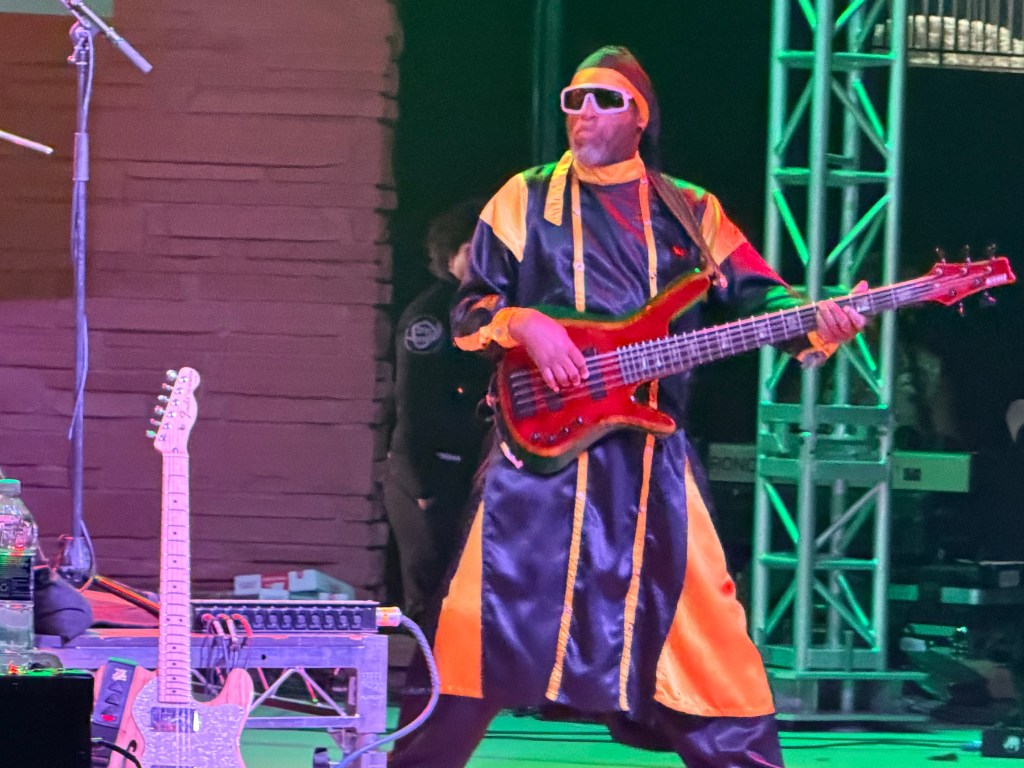
In 2005, Amlak joined Steel Pulse as their bass guitarist, replacing Alvin Ewen. Despite the band’s demanding tour schedule, Amlak remains committed to community upliftment. He is a dedicated mentor and workshop facilitator, working with organizations like East Staffordshire Racial Equality Council (UK), Express Yourself Youth Projects (USA), and Biruta (Brazil). He regularly visits schools and correctional facilities, aiming to connect with youth who may feel unreachable by traditional voices.

A powerful advocate for reggae’s cultural integrity, Amlak has begun sharing his insights through public speaking. One of his key messages centers on preserving reggae’s historical and spiritual roots. “There’s reggae reggae everywhere, but not a Rasta in sight,” he says, not as a critique of non-Rastas, but as a call to remember reggae’s foundation in Rastafarian consciousness and the struggles that birthed it.

Amlak believes that reggae, like a great tree, cannot thrive without its roots. “No matter how big the tree, without the roots, it will topple. But it’s not a one-way thing, the tree needs the leaves and fruit too.” He emphasizes that although reggae was born from sufferation, every generation connects to the music in different ways. “The younger generation in the U.S. may vibe more with surfing, weed culture, and sunshine. That doesn’t mean their reggae isn’t real, it’s just from a different lens.” For Amlak, the key is understanding the lineage. “You’re wiser if you know where you come from. Peace, love, and unity, that message remains the same.”

Amlak holds a Bachelor’s degree in Popular Music, a Master’s in Musicology, and is currently pursuing a PhD. His work is as diverse as his resume. He sits on the board of E.P.I.C. (Environmental Protection In The Caribbean) and is partnering with Professor Paul Sikkel of the University of Miami’s Rosenstiel School on a new initiative, details of which remain under wraps for now. Their connection began when Professor Sikkel named a newly discovered Caribbean parasite after Bob Marley, sparking controversy in the Rastafarian community. Amlak helped bridge the cultural gap in a thoughtful and widely viewed YouTube interview.

New musical releases are on the horizon, and fans can stay updated through Amlak’s Instagram @amlak_tafari the TiReD TaFaR oN ToUr, where he entertains thousands with his spontaneous “You are now live, which means I am A-Live” broadcasts, his way of giving thanks and keeping the connection real. After every reggae show, Amlak makes time to meet fans, ask questions, and spread positive energy.

His live speaking series, From Handsworth to Hollywood, serves as a living autobiography, tracing his journey from near-death at the hands of police to international acclaim with Steel Pulse. These talks are informative, humorous, and deeply moving, and he’s available for Corporate, Entertainment, and Motivational events.

From cardboard instruments to global stages, Amlak Tafari’s journey is still unfolding. One thing is clear: this Am-BASS-Ador of reggae is far from done. From Handsworth To Hollywood, his reggae journey is just the beginning.

Perfect Giddimani Celebrates 25 Years of Reggae Classic “Handcart Bwoy” with Special Anniversary Edition

Some songs define a moment. Others define a generation. Twenty-five years after “Handcart Bwoy” first rolled onto the reggae scene and became one of Perfect Giddimani‘s signature recordings, the beloved anthem returns with a special 25th Anniversary Edition, celebrating a legacy that continues to resonate around the world.

Produced by Sinky Beatz, the anniversary release breathes fresh life into a reggae anthem that has remained a staple for sound systems, selectors, and reggae lovers across generations. While the production has been refreshed for today’s audience, the heart and spirit of the original remain firmly intact, honoring the song that helped establish Perfect Giddimani as one of reggae’s most respected voices.

Originally released at the turn of the millennium, “Handcart Bwoy” quickly became more than just a hit record. Its infectious rhythm, relatable storytelling, and authentic Jamaican spirit resonated with listeners both at home and abroad, helping the song transcend borders and cement its place as a modern reggae classic.

Now, a quarter-century later, Perfect Giddimani revisits the anthem not as a nostalgic exercise, but as a celebration of its remarkable journey. The 25th Anniversary Edition serves as both a tribute to the fans who have carried the song through the years and an introduction for a new generation discovering its timeless appeal.

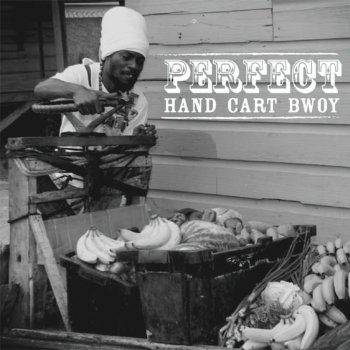
Left: The original Handcart Bwoy artwork that introduced reggae fans to a future classic. Right: The 25th Anniversary Edition, celebrating a song that has continued to roll through sound systems and playlists for a quarter of a century.

Reflecting on the milestone, Perfect Giddimani shares:

“Handcart Bwoy is officially pulling up for its 25th Anniversary Edition! The legendary anthem that started a movement gets a fresh life. From the streets to the world stage, this one is for the day-ones, the lovers of real reggae music, and the entire global family that has kept the wheels rolling for a quarter of a century.”

Produced by acclaimed musician and producer Sinky Beatz, the updated version blends contemporary production with the unmistakable energy that made the original a standout, creating a record that feels both familiar and refreshingly new.

As reggae music continues to evolve globally, “Handcart Bwoy (25th Anniversary Edition)” stands as a reminder that truly great songs never lose their relevance. They simply find new audiences while continuing to inspire those who have loved them from the beginning.

“Independent Does Not Mean Amateur”

“Independent does not mean amateur” is the guiding principle of producer and publisher Jon K.T., who emphasizes that being an independent artist requires mastering the business of music as much as the art.

Jon’s love for music began with drumming. Inspired by his mother’s Motown records, Jon started drumming at age eight, using a pair of chopsticks on the couch. He quickly discovered that different parts of the couch created different sounds. His makeshift drum set evolved, progressing to Tupperware and eventually to the church drum set when he was tall enough to reach the pedals. From there, Jon added guitar and keyboard to his skills, thanks to his uncle, who gifted him his first keyboard, sparking his journey into songwriting at just 14.

After finishing school, Jon worked as a carpenter, later moving from England to the U.S., where he joined Sony. Despite his day job, he remained deeply involved in music, performing and creating with various bands. When the 2008 recession hit, Jon lost his job, which led him to rethink his career. Determined to stay connected to his passion, he enrolled in an associate’s degree program in audio engineering at Madison Media Institute. There, he earned his Recording Technology degree, became Pro Tools certified, and stepped into the world of professional studio engineering. His degree opened doors: Jon first worked as a tutor and later joined a translation company, where he recorded, mixed, and mastered multilingual sessions for instructional videos and TV commercials.

Seeing a path forward, Jon pursued a bachelor’s degree in Music Production and later established his own production and publishing company. Though he initially focused on reggae, his studies in music theory expanded his sound, creating a fusion of gospel, pop, hip-hop, and reggae. With a promotion in his day job, Jon took on another educational challenge, earning a master’s in Entertainment Business, where he learned marketing, management, copyright law, and licensing essentials.

In the last five years, Jon has dedicated himself to educating independent artists on the music industry’s ins and outs. His mantra, “independent does not mean amateur,” serves as a reminder that while independence allows freedom from corporate influence, it requires the discipline to meet industry standards.  For example, why spend thousands of dollars to record your song or music without hiring someone to market it for you?  Another example is producers who sell tracks they made but don’t get credit for them. The people who create the music are creators, too. That’s why producers must go through publishing and buy a license to get their residuals. Also, it’s vitally important to copyright your song with the Library of Congress in the USA,  or whoever handles copywriting in your country.  Artists and Producers can find all the relevant information about the process online.

For instance, Jon often receives tracks with generic names like “Audio 1” or “Audio 2,” etc, instead of “guitar, drums, vocals, etc.”, a setup that frustrates engineers who then waste time relabeling each track. He encourages artists to take full control, advising them to invest in marketing, protect their work, and understand the business framework.

Jon emphasizes the importance of proper labeling and tagging when sending music to radio stations or attaching it to music videos. Essential details, like song title, artist name, songwriter, album title, and ISWC code, allow licensed radio stations to track plays and ensure payment. In the U.S., artists can license their work with organizations like BMI or ASCAP, which issue ISWC codes for performance rights and ISRC codes for streaming. Jon notes that generating income takes around 50,000 mainstream radio plays or 100,000 independent radio plays. He advises artists to report every live performance to their respective rights organizations for additional royalties.

Jon reminds us that independent artists don’t have to be amateurs. Independence in music is about taking responsibility, protecting your work, and ensuring that every performance and every play counts—on your terms.

Jon K.T. must be doing something right, as he’s just been awarded The Rampage Music Awards Multi-Artist of the Month for October.

A Tribute To Madi Simmons

When I begin working with an artist, they quickly become family. Through weeks of conversations, collaborations, and shared experiences, bonds form that go beyond professional connections. I started working with veteran reggae artist Madi Simmons in 2021, and from the very beginning, I knew he was someone extraordinary. It didn’t take long for him to become an essential part of my life. Madi had a way of reaching out almost every day—whether it was to “check in,” ask for feedback on a song, or share his thoughts on politics and the state of the world. Those conversations often sparked ideas for his music, as his creativity was deeply intertwined with his observations and reflections. Thankfully, we saw eye-to-eye on most things, so our discussions flowed effortlessly. When Madi shared that he wasn’t feeling well, I wasn’t prepared for how swiftly cancer would take him away.

“Hailing from the United States, Madi Simmons entered the performing scene at the age of 16. He started out playing the drums, songwriting, and singing. Throughout his life, Madi’s key musical influences have been Smokey Robinson, Marvin Gaye, John Bonham (Drummer), Bob Marley, and Peter Tosh, and that’s just to name a few. There are many other influences that you can hear in his voice.
Madi has a wide musical range and can send your mind to a nostalgic place……with vibes that remind us of Black Uhuru and a voice that combines Gregory Issac, Peter Tosh, and Dennis Brown into one, Madi Simmons is still pushing out his sweet reggae music. Mainly known for playing drums and having a strong vocal delivery, Madi learned over the years to perfect that one drop among other styles, though, as you will hear, his preference is to use his voice.
He has toured quite a bit in the last 20 years, performing on stages from the Pacific Northwest, California, Hawaii, and the Midwest to the West Coast. Madi has appeared at major events such as Cougar Mountain Fest, Benbow Summer Art Fair, Unity Fest, North Country Fair, and even Reggae On The River as an Emcee and performer. Now, he is sparking interest in Europe and other parts of the world
Madi was also voted best indie artist on two different showcases, Review Indie
http://reviewindie.com/2021/05/madi-simmons-is-an-award-winning-reggae-singer-songwriter/
and Top Indie Artist 2018 on Shyrick Radio
Madi Simmons has a catalog of albums dating back many years including Get You Some 2005, One Love EP 2008, Reggae Against Landmines – Volume 1 2011, Reggae Against Landmines – Volume 2 2011, Reggae Against Landmines, Vol. 3 EP 2012
My Time Is Now – EP 2012, A Time For Love – EP 2012, Dread & Alive Kindah, Vol. 4 2012
Madi Simmons continues to “speak to you through the music” on current issues that touch his heart.”

During one of our many heartfelt conversations, Madi once confided in me that he didn’t believe he would ever achieve true fame in his lifetime. He speculated that recognition might come only after he was gone. What he didn’t realize was just how deeply he had already touched so many lives. In the hours following the announcement of his passing, my phone was flooded with calls and messages from people sharing their grief and recounting their personal stories about Madi. They spoke of his compassion, his willingness to share his own struggles to uplift others, and his daily calls to check in on those who were sick, grieving, or simply in need of encouragement.

I had the privilege of spending time with Madi at the Sierra Nevada World Music Festival in 2023 and Reggae On The River in 2024—two festivals where he had performed and served as an MC in previous years. The love and respect he received from everyone he encountered at these events spoke volumes about the kind of person he was.

Madi, your presence will be deeply missed. It was a true honor to work alongside you and call you a friend. Until we meet again, rest easy, my brother.

Reggae On The River Overview

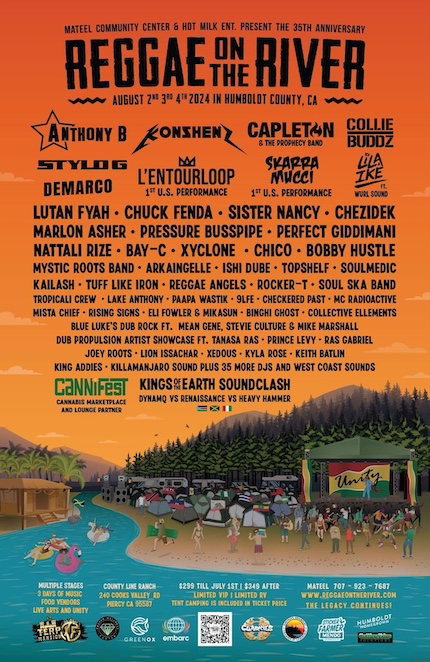
After a six-year hiatus and the cancellation of the Sierra Nevada World Music Festival, anticipation for Reggae On The River’s return was reaching fever pitch. With a stellar line-up including headliners like Reggae legends Capleton, Anthony B, Collie Buddz, along with many other favorite artists, a good smattering of locally based Reggae artists, and an abundance of DJs and Sound Systems, this festival was looking to be something special.

Reggae On The River was established in 1984 as a non-profit event to raise funds for a new community hall in Garberville, California, after the original hall was destroyed by arson. Over the years, the festival became a beloved gathering for Reggae enthusiasts from Northern California and around the world, with many fans traveling great distances to attend. The event was set against the backdrop of the majestic redwood trees and the scenic Eel River. Despite facing challenges with location changes, Reggae On The River continued to thrive for many years. However, in 2019, the festival was canceled due to ongoing difficulties securing a stable venue and declining ticket sales. After the pandemic lockdowns were lifted in 2022, the event did not return due to issues with obtaining venue permits. Reggae On The River 2024 started with conversations between Hot Milk Entertainment and The Mateel organization a few years ago. Still, after many hours of negotiations, it was abandoned because of continuing venue issues. In 2023, it again came to the forefront, and with the “never give up” mentality of the entities involved, the venue issue was finally resolved. Reggae On The River 2024 was about to happen.

With a media pass to Reggae On The River 2024, I was able to set up my campsite on Thursday, the day before the general public was admitted. This gave me an insight into the preparations for the festival. The stages were being set up, the vendors were arriving and setting up their booths, and the multitude of volunteers were having training meetings for their various roles.  The stage crew worked until 4 am Friday to ensure everything was in place and working correctly for the festival commencement at noon on Friday.   I had been checking the weather forecast for a couple of weeks to see what temperatures to expect. Two weeks before, temperatures were predicted to be in the 60s F, but then it changed to the 80s F, which sounded perfect. Nothing prepared us for temperatures that reached the 100s F. The unexpected and extreme weather conditions, with temperatures averaging high 90s F to low 100s F, were definitely challenging and added a unique element to the festival experience.

Friday dawned extremely early, with a very loud “Happy Reggae” blasting out over the site. I did become used to it and slept through it after the first morning.  The public started arriving at 10 a.m. It was exciting and inspiring to watch streams of excited Reggae fans, and their families pour past my tent site, towing wagons, strollers, and children of all ages, heading to the main gate.

The festival commenced with a Native American prayer and dance, a tradition of Reggae On The River, and the festivities began.

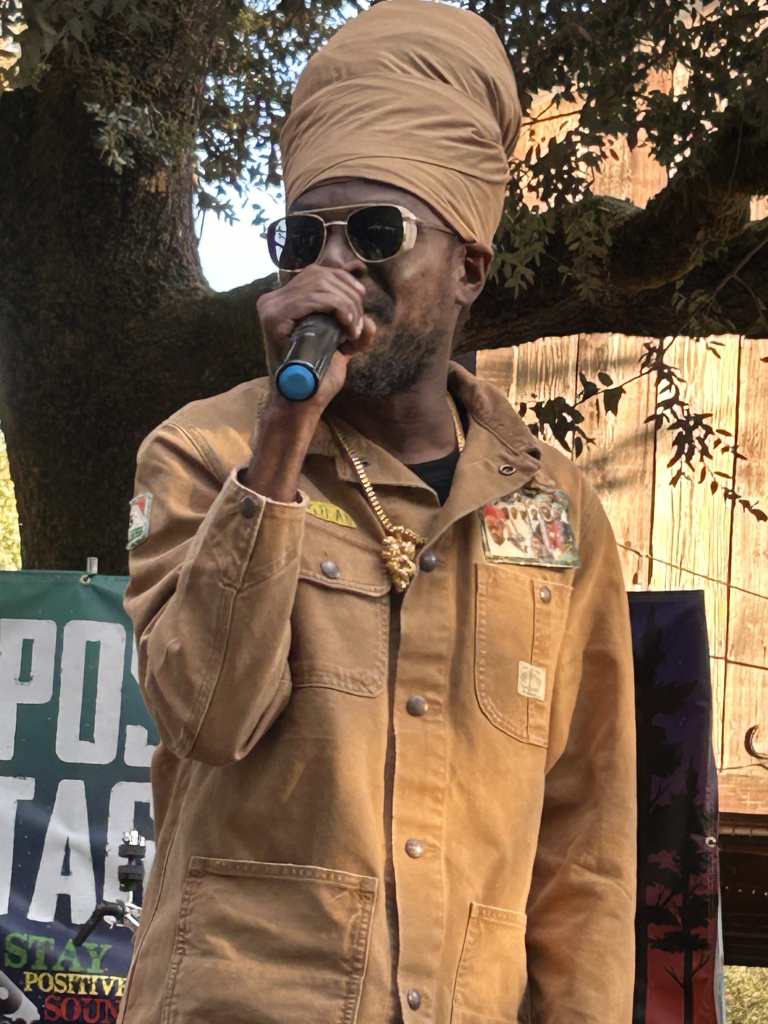
Three stages were set up: the Main Stage, the Positive Stage, and the River Stage. On Friday, the performing artists on the different stages were staggered with DJs playing between acts, so there was time to go from one stage to another without missing the artists performing on any stage. There were performances by artists like Chuck Fenda, who thrilled us with a stellar performance, especially when he performed from the stage scaffolding,

Pressure Busspipe, Perfect Giddimani, Nattali Rize, Yaadcore & Yaksta, and rising star 13-year-old Kailash,  with performances spread over the three stages and  DJs and Sound Systems playing in between.

The culmination of a magnificent first day of the festival was an outstanding performance by Anthony B, who had undergone life-saving surgery only days before. Despite this, his performance encompassed the usual exciting, energy-filled experience his fans have come to expect, but minus his iconic leaps and bounds. 

Day two dawned bright and early. When camping at a festival, porta-potties become incredibly important. As seasoned festival campers have realized, hanging on until the porta-potty company has done its morning clean makes for a more pleasant experience. High five to the porta-potty company, which came several times daily and did its best to keep them clean. This was important to me as I was camped opposite a set of porta-potties. The festival provided a shower block; although small, this was a welcome addition, especially as it was so hot. By Saturday,  weekend campers had made friends with their neighbors, and little families were formed with folks sharing and helping each other out. One of the most popular vendors of the weekend was the ice vendor, and columns of ice-carrying mums, dads, and kids were seen every morning making their way back to their campsite. The festival atmosphere was filled with a sense of camaraderie and shared experience, making it a truly unique event.

The second day of performances,  in my opinion, didn’t flow quite as well between the stages. The artists performing weren’t staggered as they had been on Friday, so it took some planning to see all your favorites. The lineup for Saturday was packed with artists like Lutan Fyah, Konshens, Lila Ike, Chezidek, DeMarco, Isi Dube, and newcomer Jamaica’s female artist Tuff Like Iron, to name a few.

It was refreshing to see the unity between young West Coast artists such as Arkaingelle, Yungg Trip, Jahdon Blakkamore, and local Sound Systems, who introduced us to new artists by allowing them a guest appearance on their set. 

The highlight of the day was the highly anticipated appearance of the legend Capleton with a magnetic performance that closed out the main stage. This was not the end for festival-goers, though. If you had enough stamina, the Kings Of The Earth Soundclash was scheduled,  featuring Dynamq from South Sudan, Renaissance from Jamaica,  and Heavy Hammer from Italy. This took place on the River Stage and started after the Main Stage closed for the night. Some people did not fully understand this staple of Jamaican culture and were disappointed that they couldn’t dance, but for those aficionados of sound clashes, a good time was had.  

Sunday morning likely arrived a bit too soon for those who partied through the sound clash, with the Positive Stage and River Stage kicking off at 10:30 a.m. Thankfully, the Main Stage offered a gentler start time at 1:30 p.m. But the wait was well worth it. Sunday’s lineup delivered a spectacular finale to an unforgettable weekend, featuring an array of talent that electrified the crowd. Performances by Bobby Hustle,

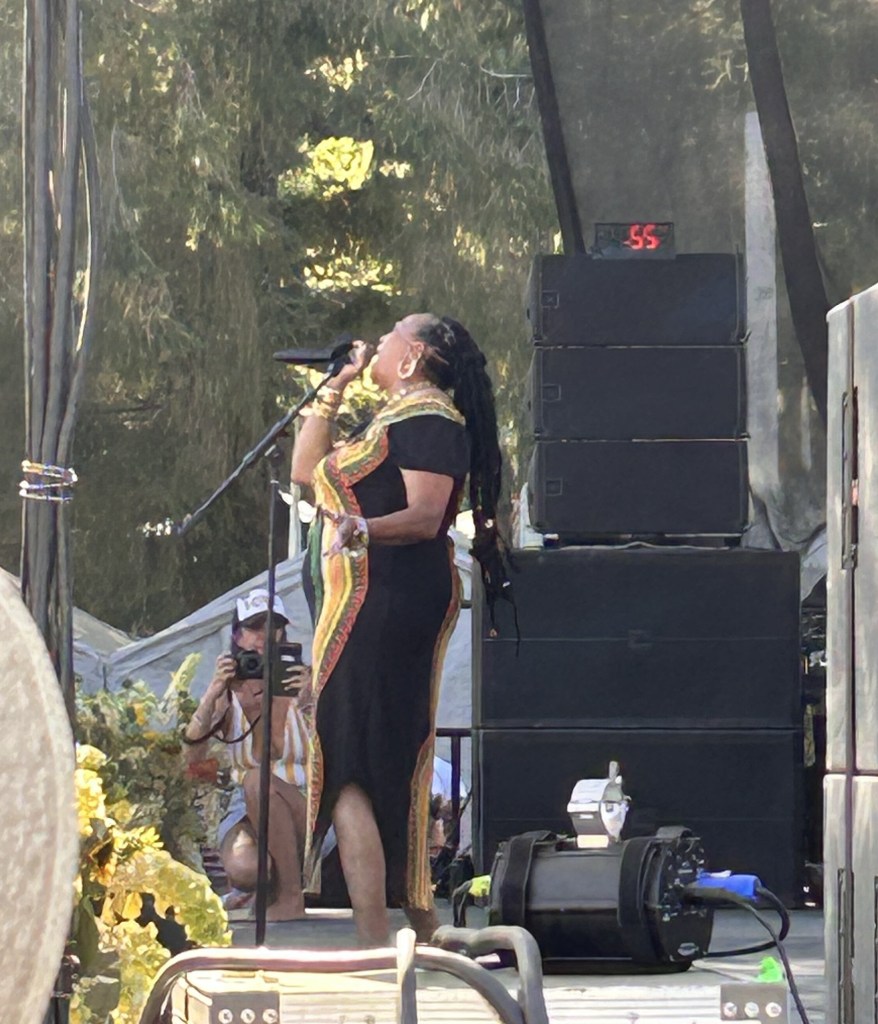
Iba Mahr, the legendary Sister Nancy,

and the iconic “Ganja Farmer” Marlon Asher, set the tone. J-Boog, the high-energy Soul Ska Band, and Soul Medic, to name a few, with an assortment of DJs and Sound Systems keeping the vibe alive. The weekend reached its pinnacle with Collie Buddz, who had the entire crowd singing along to his classic ganja anthems. For those still eager to dance, the festivities continued at the after-party with Ashanti Hi-Fi and King Addies, followed by surprise guest DJs that kept the energy soaring well into the night.

Overall, the triumphant return of Reggae On The River was nothing short of spectacular. While a few fans raised eyebrows at seeing artists of Chezidek and Perfect Giddimani’s caliber performing on smaller stages instead of the Main Stage, this may be a hint at what’s to come for Reggae On The River 2025. Some disappointment lingered among Skarra Mucci’s fans when his visa issues prevented him from making the festival, but such hurdles are beyond the control of both the event organizers and the artist.

The festival offered a rich tapestry of experiences, with a diverse selection of vendors selling everything from clothing and art to food and drinks. Families enjoyed a dedicated children’s zone, while the Cannabis Area highlighted local growers and sponsors, even offering tours of the surrounding cannabis industries for the curious.

Reggae On The River still stands as a true multi-generational festival, celebrating the spirit of reggae and bringing together fans of all ages.

Behind the Board: A Conversation with Grammy-Winning Engineer James ‘Bonzai’ Caruso

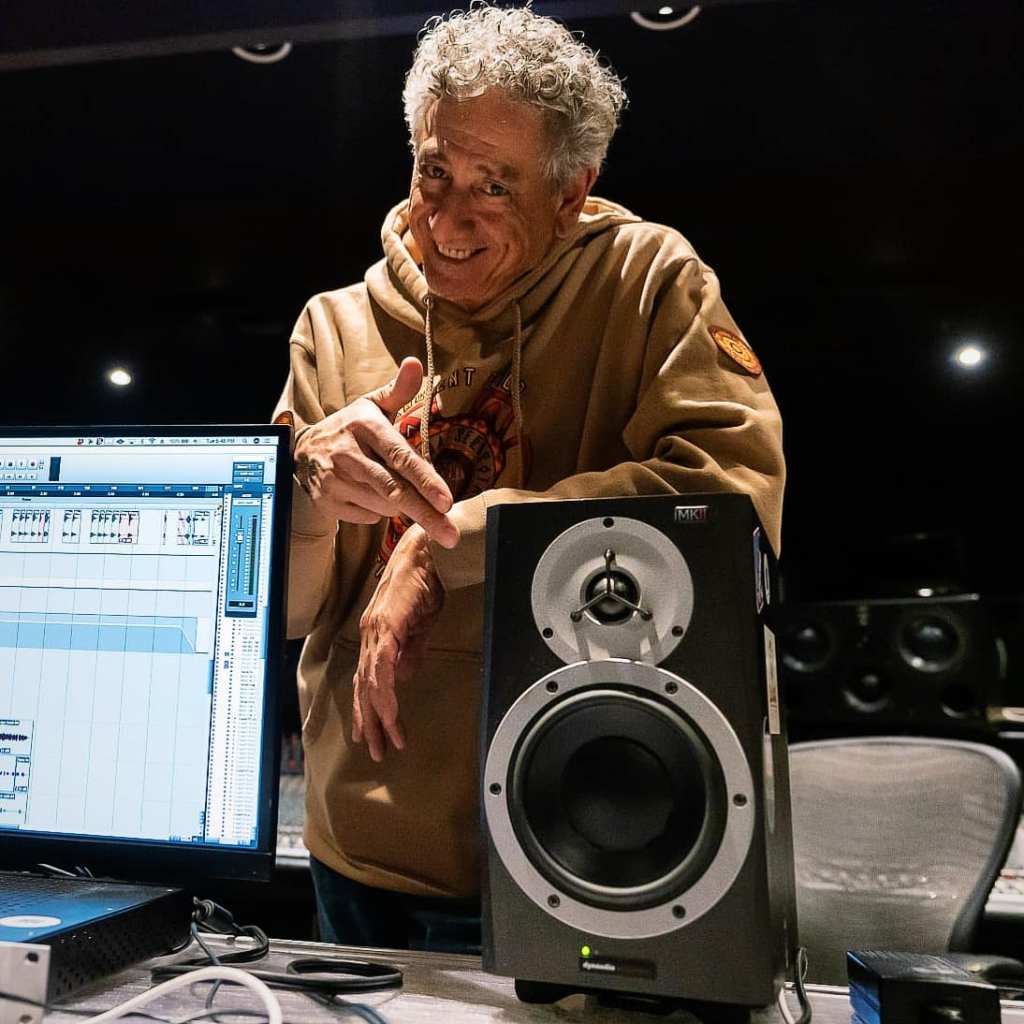
I’ve always been captivated by the magic behind the music—the unsung heroes who bring songs to life from behind the scenes. So, when I had the chance to sit down with James ‘Bonzai‘ Caruso, the legendary recording and mixing engineer with six Grammy wins to his name, I knew I was in for an extraordinary experience.

JEN: Let us start at the beginning. You mentioned you were 17 years old when you started this studio engineering journey. What sparked your interest in this field?

BONZAI: As a young teenager, I was a guitar player. I was studying guitar and listening to lots of records and I was fascinated by the quality and the sound and placement of instruments. My hearing just picked up on each individual, part and arrangement of the songs, especially growing up in the ‘70s.  There was great music in the ‘70s.  But when I graduated high school at the age of 17,  I grew up in the countryside in New Jersey, and I worked on horses, on horse farms, and I had to care for chickens and hundreds of acres of farmland. So I went right to New York City, which is about an hour and a half away, after I graduated high school.  I signed up for a course at the Institute of Audio Research, which was part of NYU at the time. After a couple of months in school there at NYU, I was placed in an internship at a recording studio called Secret Sound Studios,  which would have been previously owned by Todd Rundgren. When I first started as an intern, they paid me $5 a day. I worked 90 hours a week.

JEN:  At least you got paid something. A lot of interns don’t get paid. 

BONZAI: I got a sandwich every day.  I just dug into learning, how to use microphones, and the patch bay, and how to use compressors and equalizers and reverbs.  I just was a sponge soaking it up. I was very fortunate to have that opportunity.

JEN: So, who was your biggest influence in the world of audio? 

BONZAI: At that time,  I was a big fan of the band Yes, from the UK, and later when I was an intern at the studio, Trevor Horn became a producer. He did that record, “Owner Of A Lonely Heart” from the album “90215” and I was just completely blown away by the sound quality, by the production, by the mixing, the use of samplers.  Sampling was a brand new thing then. We had the emulator and a couple of other keyboard samplers at this time, that were fresh on the scene, and he was utilizing samples, and I was just so inspired. Trevor Horn was a really major influence on me.

JEN: Can you describe a typical day in the life of a studio engineer? 

BONZAI: No!! Because there is no typical day. Every day is different, and it really depends on the project. It depends on if we’re recording, if we’re mixing, if we’re editing, or overdubbing. So if it’s a typical day of tracking, it’s setting up microphones for 

drum kit, bass, guitars, amplifiers, and singers,  In a live situation, recording a band, that would be a typical day. In an overdub session, when you already have tracks laid, you might be just setting up to overdub strings or horn section, or possibly vocals. In a mixing scenario, a typical day would be coming in, and tracks have already been produced and recorded.  I would just be focusing on mixing, so a typical day in a mix session would be just be blending and balancing and getting a good mix. 

JEN: Do you get whole bands in the studio at one time? 

BONZAI: I look forward to those, especially with Stephen and Damian (Marley), especially with Stephen Marley, and we’re tracking his band, or any band, for that matter.  I just love tracking live drums, bass guitars, live instruments, with 6,7,8 people in the room. That vibe, I just love it so much.  Unfortunately, in the last five or ten (years), especially the last five years since the pandemic, I haven’t been doing very many of those sessions, and I miss it, because those are my favorite sessions.

JEN: What are the biggest challenges you face in your work, and how do you overcome them?

BONZAI: The biggest challenges today is, I mean, there’s been a lot of challenges over the years, but most recently, in the last decade or so it has been the volume wars. Everyone wants everything so loud, so it’s always, push, push, you know, and that’s one of the most challenging things, ‘cause I love dynamics.  I love when songs get quiet, and they build, and they get louder and they get quiet again. So much of today’s music is just so in your face, and that’s fine, I mean, I’m embracing it, and I’ve gotten good at it,  but it’s one of my least favorite things, so it is challenging. One of the other challenging things is when I get sessions that have been recorded wherever, Jamaica Australia,  Europe, and they’re not recorded that well, and I’ve got to polish that, you know what I mean. That’s a big challenge ‘cause now I’m doing a lot of fixing before I start mixing. I’m hired to do the mixing, and now I’ve got to fix the drums, fix the timing, ‘cause the bass player’s not on time, or the guitar player’s off, or the singer’s out of key. Pitch correction.

JEN:  I know that must be a challenge. I can hear things, I can’t do it myself but I can hear when it’s off. It hurts my ears. People laugh at me when I say that, and I say, “No, it physically hurts my ears”

BONZAI:  Yeah, it’s not fun. 

JEN: I’m glad somebody else feels that.

BONZAI: I can hear. It can be the bass, a guitar, be one string on a guitar, it

 could be the vocalist, it could be anything. Like, “ No, that’s not right”.

 I’ve worked with Cher, she has perfect pitch. Some other people I’ve worked with, keyboard players, and string players that have perfect pitch, and it’s really a gift.  

JEN: What are some of the key pieces of equipment or software that you rely on?

BONZAI: I’m an analog fanatic. I love working with analog stuff, but the key components that are most important are equalizers, compressors, reverbs and delays. I would say those four.  Now in the software that’s around, plug-ins. A lot of these plug-ins are designed to emulate the old tube equipment from the 60s and 70s. But yet, I would say the equalizers, compressor, reverbs and delays are the most important pieces. Another extremely important piece of equipment is your monitor, your speakers. The quality of your speakers, of what you’re listening to, depending on how true they are, is very, very important because then it translates accurately. If you’re hearing a lot of bass and treble, when everything’s balanced really nice, but then you go in your car and it sounds like mud, then it’s lying to you, and it’s not going to translate. Speakers are very important. The key is to make it sound good on everything, yeah that’s the key. 

JEN: Can you share a specific technical tip or trick that you used to achieve a particular sound or effect?

BONZAI:  Oh! There are so many.

JEN:  Do you have one that’s specific to you, that you use?

 BONZAI: I don’t know about specific to just me because a lot of these tricks have been tried and true and have been around for you a long time. They’re just concepts and ideas and tricks, if you will, that work, for instance, side-chaining compression, so that certain instruments will get out of the way of other instruments when they play.  You will send a signal to it to kind of duck the other thing when it plays, and then it comes back, so they make room for each other.  It’s called side-chaining and ducking.

JEN: That’s cool.

BONZAI: Yeah! That’s a really cool technique to use when things are fighting each other, and they’re both fighting for the same space, but you want one to be more apparent than the other,  and you just send that one to attenuate, to lower the volume of the other one. It’s been around for a while. It’s also in the analog role. It’s been around. JEN: I’m going to ask you a controversial question. What do you think of the use of auto tune, the way it’s being used now?

BONZAI: Auto tune. I don’t know. It’s a love-hate relationship.  It’s a useful tool for certain things. It’s a great effect,  even if you don’t need it on a singer.  I used it on Cher. I worked on that “Do you believe in life” song, ( “Believe” from her 1998 album “Believe”)  I did her live concerts with that.

JEN: Wasn’t it Cher who brought it to the forefront? 

BONZAI: But she didn’t need it. It was an effect. She has perfect pitch. We were just using it as an effect because it was a new box, it was a new toy, it wasn’t software yet, it was an actual piece of gear. I did Jay Leno’s show with her and David Letterman and a bunch of TV talk shows and some live shows.  I used to bring it with me and have her with two microphones, one set at normal voice and one with the effect and then when she wanted to go to the effect, it was up to her.  So she had to remember to put tape on them to say “This one for the effect, this one for normal”.  I still love using auto tune in that regard, but not on everything. But then, as you know, a lot of artists rely on it, they use it on full-tilt stun mode all the time, and it is what it is.

JEN: Then there are artists that use it because they can’t sing. 

BONZAI: And then there’s that.

JEN: But what about when they go live?

BONZAI: They’ve developed a live version of it now,  that works in real-time, so they can use it on stage now, too,  even if they do sing off-key. 

JEN: How do you handle technical difficulties during a session?

BONZAI: One of my specialties. I was dealing with one today and last night.  They always come up.  I’ve really gotten good at tracing the signal, you know, troubleshooting and finding the source.  So I can detect where it’s coming from, I use a process of elimination, to track it down, to track the signals to where there’s the problem.  You know it’s not from the source,  you know it went from here to here, to here, to here. The problems right there, so you’ve finally traced it.  You just backtrack, and you find where the problem is, and you fix it.

JEN: Do you have a memorable troubleshooting story?

BONZAI: Oh, gosh, oh gosh, yeah, I do. I’ve got so many.  Back in the day, I was doing Bob Marley’s “Chant Down Babylon” remix album with Stephen and Damian (Marley). I had to take Bob Marley’s original analog two-inch tape, multi-tracks, regional ones, and put it into the computer so we could chop up his vocals, put a new beat, and have guest vocalists. We had Erica Badu on one, and Aerosmith and a whole bunch of different artists featured on every different song on that album. So our multi-track machine is set up in the head stack for the heads to play back. The multiple tracks are set up in banks of eight, so you went  1 through 8,  9 through 16, and 17 through 24. So all those channels would come up on the board. That’s the original tapes, so I couldn’t play it too many times, it’s falling apart as they play. So what you do is you bake the tape in the oven at 400 degrees for about 6 hours.

JEN: That would scare me.

BONZAI: It adheres the metal particles of the tape to the myelar backing,  so you can get some plays out of it before it falls off and is gone forever.

JEN: Wow!

BONZAI:  I was under a lot of pressure to make it happen. So I was doing it, and the tape machine, the multi-track machine, was only playing back 1 through 8, 9 through 16 but it wasn’t playing back 17 through 24. So  I’m missing eight tracks and some of those are Bob Marley’s vocals, and some of them were bass, for different songs.  I’m like, “Oh my God! What am I gonna do?  We’ve gotta get another machine in here or something.” Then I came up with a brilliant idea. I would transfer the 1 through 16, and then I turned it upside down and played it backwards, 1 through 8 was now 17 through 24 backwards, so I put it in the computer backwards and then flipped it forwards in the computer and lined it up.  Everyone was like, “What did you just do?”  I had to find a workaround at two o’clock in the morning and where were we gonna get another machine.  We’re in a studio in Miami, and I’m like, “What am I gonna do? I don’t have channels 17 and 24, they’re not playing back. I’ll start over. It’ll be 1 through 8, but it’ll be backwards but in the computer it will be forwards”.

JEN: Wow! So, did it have the crackle that you get on originals?

BONZAI: They had the noise, tape saturation, and tape hiss. Yeah. Cassette noise, but the crackle, that’s from vinyl.  But actually, sometimes we’ll do that too.  Like if you listen to “Welcome to Jamrock”,  we dropped the needle on any old record, at the beginning before the song, I just took three seconds of it, looped it, and put it all the way through. We do this sometimes and make it sound like you’re playing vinyl, but you’re not playing vinyl.  Yeah, cool trick. 

JEN: Now  I’m gonna go back and listen to it again, knowing that. What is the most memorable project you’ve worked on and why?

BONZAI:  I’m so blessed with so many. “Chant Down Babylon”  is definitely one of them. Recording the Marley’s in Ethiopia for what would have been Bob Marley’s 60th birthday.  We went to Ethiopia and did a concert called Africa Unite, and I had to set up a recording studio on the stage in Addis Ababa. The concert was from noon to midnight with all the Marley brothers, Lauren Hill, I forget who all we had. We also had some local Ethiopian artists. I got to record for 12 hours straight with 110,000 people in the audience. I built this video on stage and I got to record the show on multiple, multiple, multiple hard drives, all running simultaneously.  Now the voltage for Ethiopia is not very steady, and I’m watching the voltage go from 110 to 126 to 110. I thought, “Everything is going to crash”,  but it didn’t.  We got through it. So that was very memorable. They made a DVD of that whole show.

JEN: Do you have a funny story from a recording session? 

BONZAI: There was this really big artist. No names,  she’s a material girl. We were in the studio where I was working on her record, it’s in the mid-’90s. The configuration for her album was a digital multi-track machine, and an analog multi-track machine synced together, so 32 tracks of digital and 24 tracks of analog, connected. The studio was under the famous Studio 54. The ceiling was the dance floor of Studio 54. It’s called Sound Works. It was a beautiful studio, and she loved working there. So that particular day, I had been working there for months with her, and that particular day we were recording a string section. It was small, but it wasn’t a quartet, maybe 8-piece strings with violin, viola, and cello, for the “Erotica” album. So we set up, players were showing up, and the digital tape machine just went down, won’t play, it’s dead, and there’s only two in the whole of New York City, 3 altogether with the one we had. So I’m like, “What are we doing? We’ve got these string players coming,  she’s on her way. How am I gonna make the session happen? I’ll call the other studios, maybe we’ll just go to the studio that has that particular machine”. It’s a Mitsubishi X85 machine, 32-track digital. I’m like, ”I’ll just call.”  So I called the first studio,  “No, we’re booked today.  You can’t come in here”.  I’m like trying to make it happen for her.  The string players were very expensive,  you know, they’re all Juilliard students or the Philharmonic. So there’s a studio upstairs in the same building, on the roof, called Axis. It’s no longer there.  So I called them up and said, “You wouldn’t happen to have the day available today, would you?” They’re like, “ Yeah,  actually, we do have cancelation today.”  I said, “ Can we come up? All we have to do is get in the elevator.  This is so convenient.”  So we all get in the elevator, including her husband.  So they’ve all been told who we’re working with.   We get in the elevator, and it’s so funny,  I’ll never forget it. We get up to the top floor, and the elevator opens, and there’s the whole staff, so excited. They have it decked out with flowers etc., and she says, “ You call this dump a studio”  It was hysterical.  She just did it for the shock value but she’s amazing like that.  I spent maybe a year or 8-9 months with her on “Erotica” in ‘94/’95. Did all the remixes for her. She would invite me to her house for a party. We got along just fine.

JEN: What trends are you currently seeing coming up in the audio engineering industry?

BONZAI: There’s a big scene in using sample libraries, where you drag and drop. They’ve got like thousands of bass sounds, drum sounds, guitar sounds, piano sounds, and you can just drag and drop and create. It makes it easy to create stuff.  Yeah, it’s kind of cheating, but I mean it is, and it isn’t,  ‘cause I do it too. It’s a great resource for sounds. Some of the libraries are really good, and some of them are really expensive too. Yeah, trends are sort of like that. I don’t know, just outsourcing stuff makes everything easier.  You can make a track so quickly. You know it sounds great. We used to have to dial stuff in, and it would take hours and hours to make something.

JEN: How do you think technological advancements are shaping the future of studio engineering?

BONZAI:  They have and are continuing to do so, especially with the advent of digital audio in the mid late ‘90s when digital audio started really being prevalent and taking over the analog scene. That changed the ball game, it changed music completely. Things like auto tune, processors, digital processors, robot voices, those types of things are really transforming music and for music production, and the sound of songs. The ease of changing tempos or changing a key. Changing tempo is just so easy now with the advent of new technology. A few years ago, it would take half a day, now you’re doing it in 5 seconds.

JEN: That question leads into talking about this amazing new studio where we are doing this interview. Can you describe what you have here?

BONZAI: It’s called Shrine Studios in Las Vegas. At Shrine Studios, we built a Dolby Atmos studio mixing and production room. Dolby Atmos is a fully immersive audio. Our system is 9.4.2. We have 15 speakers around in a 3-dimensional space in the room for mixing. It’s formats are in Logic audio and Pro Tools. Pro Tools and Logic are two of the biggest formats for recording and mixing in music, television, and movies, and since Las Vegas is becoming Hollywood 2.0 with the advent of Hollywood’s film production studios moving here, it seemed like the perfect time to open up a room like this.

JEN:  It’s awe-inspiring.

JEN: What advice would you give to aspiring studio engineers?

BONZAI: Just be ready to immerse yourself, spend the time, and train your ears first. Number one, Train your ears. Number two, learn to play an instrument, whether it’s a guitar or piano or bass. Knowledge of music and how to play is vitally important, I think. So that when you are in the studio, and you’re working, you have that communication mindset, and you know the language, if you will. A knowledge and understanding of chords, scales, keys, are vitally important. People send me sessions, and I can fix it, but now you have to pay me to produce it or get a real producer, because I can produce the heck out of a recording and make it sound great, or I’ll just mix what you’ve got and it won’t sound great. 

JEN: What do you think is the most essential quality for a successful engineer to have?

 BONZAI: Establishing rapport. Knowing music, obviously and just, the mannerisms and the way you deal with the artist. Patience. Patience is a virtue, of course, and those communication skills. Studio etiquette is also very important.

JEN: What do you enjoy most about working behind the scenes as opposed to being a performer yourself? 

BONZAI:  I’ve done both ‘cause I have been a performer as well, but I prefer behind the scenes.  I find it a little less stressful. I like the controlled environment. That’s why we call it a control room. If a microphone starts to buzz or you have a problem, it’s just that one problem, you swap it out or whatever.  Less stressful. Just the creative workflow. JEN: How do you collaborate with artists to bring their vision to life?

BONZAI: That’s a good question actually because especially with a vocalist because as a producer, it’s drawing that emotion, putting them in that state where they’re really in the moment of the song, of delivering that message, whether it’s a happy song or a sad song. “ What is the message of the song?” Really to get them into that mindset, sometimes I’ll set up a canvas and some paint to let them just do abstract stuff while they are singing. Just to kind of visualize stuff. If you’re singing about angels, draw some angels. Just to bring out the emotion. 

JEN: So, looking back on your career, is there anything you would have done differently?

BONZAI:  Lots of things, so many. First and foremost, because I work so much, what I do becomes the song, production-wise and sound-wise. I should have asked for royalties, asked for percentages and I never did. There are so many multi-million sellers out there that I don’t have a piece of, that I should have.  If I had played my cards right,  I’d be a multi-millionaire right now. That’s the biggest one, so I’m pursuing that avenue now with things, especially now, ‘cause budgets have gone down. We are working twice as much to make half what I used to make. The ‘90s were good. People bought these things they called CDs. I put so much into it, and so much of the song was because of what I did, I took that thing out, and I put that thing back in, I filtered that instrument, and I made that double time and delay, and I changed the beat there, and there’s so much of my input, and I don’t walk away with the royalty, and that’s not fair 

JEN: Are you proud of your career as a studio engineer?

BONZAI:  I am very proud of it.  One of the things I’m most proud of is my reputation as being fair and honest.. lI show up on time. I don’t drink when I’m working. You know I take everything very seriously, and we have fun too. Keep it light,  keep it fun.  So yeah, I’m very proud of those aspects, and getting good sounds. Microphone usage. I love microphones. 

JEN: What do you mean by microphone usage?

BONZAI: Just microphone placement. Where to capture, whether it’s a violin or trumpet or a drum or a djembe or flute. You know where to place it and which model. Which mic? I love the old Vintage 2 mics from the ‘50s and ‘60s, but the best microphones are expensive.  Some I’ve gotten for my clients are $18/ $20/ $22 thousand dollars for one microphone, and you don’t drop that mic, you are careful how you handle it, and you keep it in a box. The old Frank Sinatra mics called The Telephone, called U47, and it’s got surplus World War 2 tubes, and those tubes are great. They have a life, so you don’t leave it on. It has a power supply, so tube mics like that, you don’t leave them on all the time,  you turn them off. They need a little while to warm up before you can use it. You turn it on for an hour before you use it. They can pick up a pin drop, they just pick up everything, they’re just beautiful.

JEN: What do you hope to achieve personally and professionally in the future? Don’t say you’re going to retire; I know you won’t. 

BONZAI: I mean, I’d like to retire from having to earn income. You know, to do music because I want to, not because I need to generate income. I want to get financially secure, which I should be at this point, I’m embarrassed to say. Personally that, and just become a better songwriter and improve my songwriting skills because I do write songs.  Be a better producer and just keep getting better and learning. 

JEN: Thank you, Bonzai, for a fascinating interview. I think we could carry this on for days and I look forward to seeing what the future holds for you.

BONZAI: Absolutely. Thank you!

www.shrinestudios.vegas

www.facebook.com/BonzaiCaruso 

www.instagram.com/bonzaicaruso/ 
Reggae On The River 2024

REGGAE ON THE RIVER RETURNS 

The 35th Installment of the Iconic Reggae on the River Festival Returns to Southern Humboldt County, CA, bringing top-notch International reggae headliners 

Friday, Saturday & Sunday, August 2-4, 2024.

Three days of reggae music and camping along the South Fork of the Eel River.

Tickets on Sale Now

www.reggaeontheriver.com

(Kids 12 and under free)

The 35th installment of Reggae on the River in Northern California returns to the south fork of the Eel River in Southern Humboldt County for three days of reggae, camping and irie vibes. This iconic festival brings together international headlining musical acts August 2-4, plus onsite camping, festival attractions and direct-to-consumer cannabis sales from Humboldt County’s legendary family weed farms.

Held at the beautiful County Line Ranch in Piercy, California, this year’s festival will mark the return of Reggae on the River following a six-year hiatus. Confirmed 2024 headliners include Konshens, Capleton, Anthony B, Collie Buddz, Lila Ike, Stylo G, Demarco, Skarra Mucci, Sister Nancy, plus a late-night DJ dance party on the river, and more!

Founded in 1984, Reggae on the River has grown into one of the longest-running and most beloved events on the global reggae scene while always maintaining a “homegrown” community vibe. Organized by Humboldt County’s Mateel Community Center (in conjunction with Hot Milk Entertainment)—and still run as a local non-profit with no corporate involvement—Reggae on the River has evolved over the last forty years to draw crowds of up to 15,000 people while featuring international headliners like The Marley Brothers, Toots & the Maytals, Burning Spear, Jimmy Cliff, Third World, and Steel Pulse.

Music will run from noon till late night on three stages, including a stage where attendees can listen while swimming in the Eel River.

Beyond the music, this will be the first Reggae on the River held in the age of cannabis legalization, and for the first time, will feature an official “cannabis zone” powered by Humboldt’s own Cannifest, where adults can purchase and consume cannabis products direct from the Emerald Triangle’s legendary farmers.

“Humboldt County has long been known for growing the country’s best outdoor, organic cannabis while pushing back against the government’s misguided prohibition against this beneficial plant,” says Christina Augustine, Vice President of the Mateel Community Center. “This year’s Reggae on the River is the perfect opportunity for people to come and enjoy our local produce and culture while enjoying world-class music and camping out under the stars.”

A fully family-friendly event (children under 12 admitted free with an adult), Reggae on the River also highlights local food, drinks, crafts, art and vendors. TICKETS AVAILABLE HERE

For more information, visit

www.reggaeontheriver.com

ABOUT THE MATEEL CENTER

The Mateel Community Center has fostered the arts in rural Northern California for approximately forty years. Serving as the cultural hub of the Southern Humboldt community, we provide arts, educational, and social service programs and present a myriad of multicultural musical, theatrical, dance, comedy, film, craft, and rental events- earning our non-profit organization international acclaim.

ABOUT HOT MILK ENTERTAINMENT

Hot Milk Entertainment was founded in 2022 by a few lifelong Mendocino County locals who were deeply rooted supporters of Reggae music. The newly formed company was created in order to assist The Mateel Community Center in bringing back the most iconic Reggae festival in the United States, Reggae on the River!  Its head founder is a member of the Reggae-based Soundsystem Guerrilla Takeover, which has been producing and DJing its own Reggae events in Northern California for two decades.

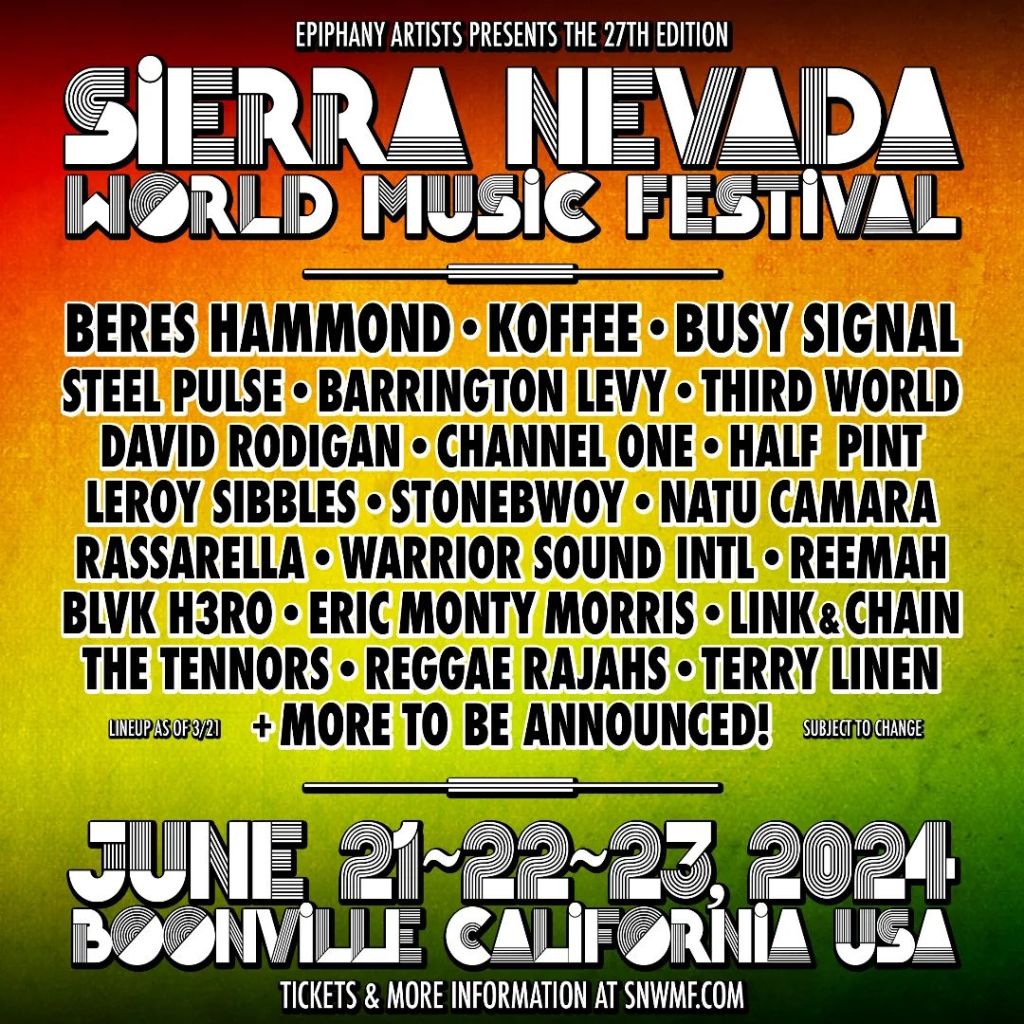
Sierra Nevada World Music Festival

Sierra Nevada World Music Festival is the place to be this Summer Solstice – June 21-23!

New acts announced 🔥

Beres Hammond

Busy Signal

Channel One Soundsystem

Warrior Sound

Reemah

The Tennors

Eric Monty Morris

Terry Linen

🎟 www.snwmf.com

Tickets selling fast, don’t miss out!

#reggae #dancehall #Ska #rocksteady #loversrock #roots #music #festival #snwmf #warrensmithlegacy #positive #conscious

More to come!!!

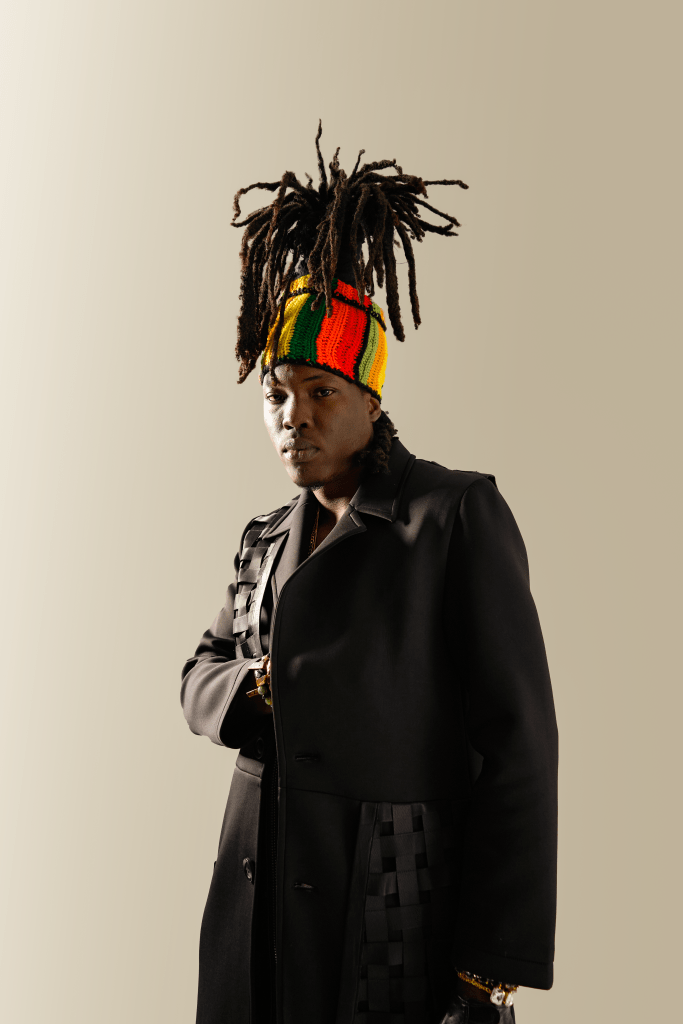
Blvk H3ro, the unsung hero.

We all know there are a multitude of musicians and singers out there, that we don’t hear about, putting out good music. Independent artists don’t have the same budget to bring attention to their music as those signed to big labels. I have always known this but recently it was brought to my attention even more by Jamaican Reggae artist Blvk H3ro. I had previously seen the name Blvk H3ro listed on some Riddim albums but nothing more. It wasn’t until he followed me on Twitter that I dug into who this young artist is.

Blvk H3ro describes himself as a Neo Reggae/Dancehall artist, to quote him, “a big pot a soup looking like everything into one”. He says his influences come from many genres of music, the secret is to create a balance between them all.

Blvk H3ro (pronounced Black Hero) was born in Waterford, a neighborhood in Portmore, Jamaica, the son of a Pentecostal deacon. Like many Jamaican youth, he grew up in the church and subsequently participated by playing drums and singing from the age of 8. The church wasn’t his only musical influence as he got older though because, within earshot of his home, he could hear the annual Sting Festival with its iconic clashes and performances by Jamaica’s celebrated Reggae and Dancehall artists. 

After High School Blvk H3ro started working in a bank to fund his ambition to attend college, as he came from a poor background and college would otherwise not be an option. A musical career was not in his plans at that time. He was foreseeing a future in finance. He quickly progressed upwards in the banking world, the bank saw his potential and was willing to pay for his college education. Unknown to the bank personnel something was about to happen that would change all that.

A new influx of employees was transferred to the bank and among them was a co-worker with whom Blvk H3ro became friendly. The co-worker told Blvk H3ro about the beats he produced in his home studio in his spare time. Blvk H3ro was fascinated by this and was invited to go to his home to see what this was about. While listening to the beats in his co-worker’s garden Blvk H3ro started to freestyle to the beats and about 10-15 minutes in they realized a crowd of people had appeared. Domino games had stopped as folks gathered around to listen. His co-worker realizing Blvk H3ro had talent said he would pay for him to have a session at a real recording studio. He said, “If you don’t like it we won’t do it again”. A week later they went to the studio and recorded. At that time Blvk H3ro wasn’t singing, it was more like rap. When he heard himself being played back, he couldn’t believe it was him. He kept asking “Is that me? Did you do something to my voice?” Looking back he realizes it wasn’t that good but the seed was planted.

After that session, Blvk H3ro was hooked. Every night was spent at the studio and he started to be late for work every day. His superiors at the bank couldn’t understand what was happening to their rising star and warned him that his tardiness couldn’t continue. Unfortunately (but fortunately for us) the warning had no effect and he was subsequently fired from the bank.  

Blvk H3ro moved out of his family home and into a house with his producer friend and another guy, using his savings and a credit card to pay for rent and studio time, often helping out when the two others were having difficulties. But like many young people first out on their own, the credit card usage finally caught up with him. He did a stint working in a call center but after seeing how employees were exploited, was very vocal about this and was subsequently fired from that position. 

Realizing the dire situation with encroaching debt,  Blvk H3ro became very despondent. He retired to his room and cried and prayed asking why he was given this talent but finances were stopping him from furthering it. A voice in his head told him that he was a hero for speaking up for his fellow workers and to keep the faith, that it would work out. He knew that there are many black heroes in the world and he had just been told he was one of them. Blvk H3ro was born. He wanted the name to stand out so he spent some time working on different ways to get it more noticeable. The number 3 has always been his number. He was born on the 3rd of the month. Inserting a 3 into Hero to make it stand out was a no-brainer, so now to change the Black. After some thought the unique spelling of Blvk was created.

Blvk H3ro became a professional artist in 2012 but life as an artist was hard. He was homeless, often couch surfing or sleeping on radio station floors, but his mission to be a voice for the voiceless was cemented. Around this time Protoje and Chronixx were emerging as the leading new conscious reggae artists and gaining worldwide recognition. Blvk H3ro saw himself as the leader of the next wave of positive reggae music visionaries, along with Samory I and Lila Ike.

Blvk H3ro released his first project in 2016, an E.P. “The H3rb Connoisseur” (dubbed THC) which led to tour dates in Europe in 2017 including performances at Reggaejam in Germany and Reggae Geel in Belgium. His debut album “The Immortal Steppa” was released in 2019 with the breakthrough track “Feet Don’t Fail” leading the way. In 2020 he collaborated with another rising artist Wayne J on a classic dancehall E.P. “New Millenium”, his first release on the Delicious Vinyl Island label, a subsidiary of the L.A.-based record label Delicious Vinyl. One of the tracks was a remix of “Young Boss” from dancehall’s young star Skillibeng.

Blvk H3ro has been mentored by some of Reggae music’s greats throughout his musical journey. Bunny Wailer brought him onstage to perform on what was to be his final tour in 2019. He subsequently recorded half a dozen tracks with him. These are the last recordings of Bunny Wailer before his passing.

 Like most artists throughout the world, the pandemic was a time for writing and recording, and In 2021 he had 3 tracks (that 3 again) included on UB40’s album “Bigga Baddariddim”. In 2022 when things started opening up again, Blvk H3ro opened shows for Reggae icons like Steel Pulse, Stephen Marley, and Collie Buddz. He had previously collaborated with Collie Buddz on the 2021 “Cali Roots Riddim”. This was a year when he was crisscrossing the U.S.A. with appearances at The Emerald Cup and Reggae On The Mountain in California. This made Blvk H3ro realize that although he wasn’t getting recognition in his own land he was reaching many other parts of the world. “These 2 million people in Jamaica, even if none of them like what you are doing, there are 7 billion people out there.” 

So far 2023 has been a busy year for Blvk Hero with appearances at Cali Vibes Festival, S.O.B.’s, SXSW, City Splash, and Sierra Nevada World Music Festival along with a memorable appearance at the prestigious Royal Albert Hall in London, England where he opened for UB40, gaining him the title of the youngest Jamaican ever to perform there. He has gained a big following in the U.K. with it becoming his highest streaming country. He believes it’s not just the music but his professionalism that has caused this. He paid his way to get there and was always on time for performances, appearances, and interviews.

Photo Credit VP Records_Ajamu Myrie

Blvk H3ro’s musical ability goes beyond reggae and dancehall as he has started to blend elements of Afro Beats into some of his music. He was nominated for a 2023 Grammy in the category “Best Global Music Performance” alongside Ghana’s Rocky Duwani for their collaboration “Neva Bow Down”. This nomination came as a total shock to him.

When I asked Blvk H3ro why he thought that even though these monumental events were happening still many reggae fans didn’t know him, he said he had observed that the music that is abrasive and derogatory is the music that gets noticed. He said that conscious reggae artists are mostly humble artists who don’t make controversial waves garnering headlines and numbers ( who is number 1 and who looks good), playing the game. He believes because he is outspoken about this he is being somewhat blacklisted and blocked. Despite that, he believes that music is organic and that his music is getting through and reaching people even if the numbers are not seen on all the Social Media platforms. “The international reggae people’s radar, especially in America, is just picking up. Perhaps I’ve been just a little too humble. They were not really paying attention like ‘Oh but wait, this dude actually has fans, and music actually enrich people, like on tour, like what?’ “ I’m doing so much but I just try to stay focussed on the work because I never get the love. So instead of just getting mad and being like ********, I just turned that into work and pray that one day. I’m actually singing good music. They would more propel the people singing negative and it hurts, but I can’t stop.”  His refusal to compromise his values for the sake of commercial success is a testament to his integrity as an artist.

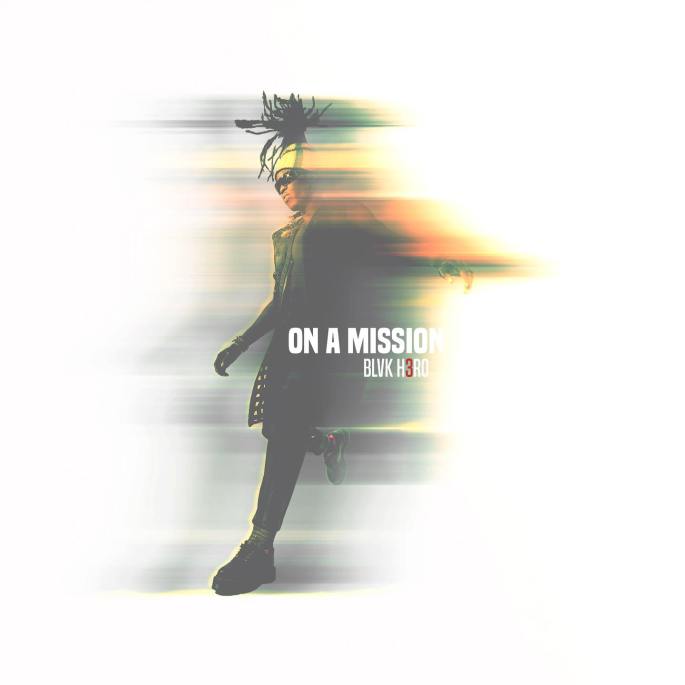
Continuing in 2023 comes Blvk H3ro’s “Annabella Remix” featuring British singer-songwriter and rapper Kojo Funds. This single led to his highly anticipated album “On A Mission” which was released on August 18th on the Delicious Vinyl Island label. This album features collaborations with artists such as Skillibeng, Teejay, Demarco, Anthony B, Dre Island, Kojo Funds, and Winky-D, and is a mix of genre-blending reggae, dancehall, and afrobeat rhythms with touches of soul and R&B. The album title reflects Blvk H3ro’s mission, “I want you to feel you’re right in the middle of whatever mission you’re on personally and relate it back to your life.” “That’s my mission, that’s my purpose”.  This album is very personal to Blvk H3ro and he is excited but nervous as to how it will be received. “I really think it’s going to be a journey but I’m nervous. Me and the team think it’s good but how good.

Blvk H3ro’s journey is a testament to the power of resilience and determination in the face of adversity. Despite starting on a completely different career path in banking, his passion for music led him to embrace his talent and pursue his dream. Blvk H3ro’s desire to be a voice for the voiceless and to create music with a positive impact underscores his commitment to social issues. His outspokenness about exploitation in workplaces and the dominance of abrasive music in the industry further emphasizes his dedication to not only making music but also advocating for change.

In essence, Blvk H3ro’s journey is an inspiring tale of an artist who defied conventional paths, faced challenges head-on, and remained committed to his vision. His story highlights the complexities of the music industry, the importance of staying true to oneself, and the transformative power of music in advocating for positive change.

Published in Red Ink Magazine